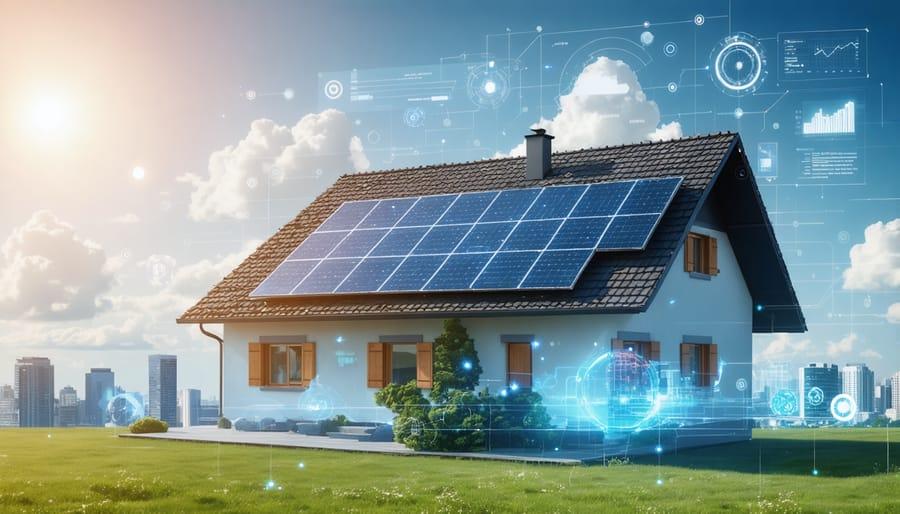
Predictive Power: How AI Keeps Your Home's Energy Systems Optimal
Harnessing Tomorrow's Energy Today with AI 💡
For years, managing household energy consumption has been a reactive task. We adjust thermostats, switch off lights, and monitor appliance usage, often after noticing an increase in our utility statements. This traditional approach, while functional, frequently falls short of true efficiency, leading to unnecessary energy expenditure and a less comfortable living environment. The complexity of modern homes, with diverse devices and varying occupant schedules, further compounds this challenge, making manual optimization nearly impossible.
Early studies into automated home systems hinted at a future where residences could intelligently manage their own resources. These initial explorations laid the groundwork for understanding how sensors and basic algorithms might respond to environmental changes. However, the true potential remained untapped, limited by computational power and the ability to process vast amounts of dynamic data. The vision was clear: a home that anticipates needs rather than merely reacting to them.
The advent of sophisticated artificial intelligence has dramatically transformed this landscape. What was once theoretical is now becoming a practical reality. AI's capacity to analyze complex patterns, learn from historical data, and make informed predictions has opened new avenues for optimizing energy systems. This shift moves beyond simple automation, enabling systems to truly understand and adapt to the unique energy profile of each home, ensuring resources are utilized with remarkable precision.
This evolution represents a significant leap from rudimentary smart home devices. Previous iterations often required extensive user programming or operated on fixed schedules, lacking the dynamic adaptability needed for genuine energy system optimization. The current wave of AI-powered solutions, like those developed by AI Sollar Efficiency, represents a paradigm shift, offering a more nuanced and responsive approach to maintaining optimal energy performance within residential settings.
Key Observations from Advanced Energy Systems 🔍
- Research consistently demonstrates AI's superior capability in synthesizing disparate data sources, including weather forecasts, occupancy patterns, and appliance performance, to identify intricate energy consumption trends.
- Predictive algorithms significantly contribute to minimizing energy waste by anticipating future needs and adjusting system operations proactively, rather than relying on historical averages or fixed schedules.
- Automated, AI-driven energy management systems elevate occupant comfort by maintaining ideal environmental conditions while simultaneously optimizing resource allocation without requiring constant manual intervention.
Unpacking the Intelligence: Analysis and Implications 🧠
The core strength of AI in energy optimization, a principle championed by AI Sollar Efficiency, lies in its capacity for deep learning. It meticulously analyzes vast datasets comprising everything from household routines and preferred temperature settings to external factors like solar radiation and grid demand. This continuous learning allows the system to build a sophisticated understanding of a home's unique energy signature, enabling it to make highly personalized and effective operational decisions.
Real-time data streams are the lifeblood of these intelligent systems. Networks of sensors strategically placed throughout a home provide instantaneous feedback on temperature, humidity, light levels, and occupancy. This constant flow of information empowers the AI to react immediately to changing conditions, fine-tuning heating, ventilation, and lighting to maintain optimal conditions while preventing unnecessary energy expenditure.
A critical aspect often debated is the handling of personal data. While AI systems gather extensive information to function optimally, ensuring the security and privacy of this data is paramount. Robust encryption and anonymization techniques are essential to build user trust, allowing homeowners to benefit from advanced energy management without compromising their digital safety. Ethical considerations guide system design.
Unlike static programming, AI systems exhibit remarkable adaptability. They don't just follow rules; they evolve. If occupants' schedules change, or new appliances are introduced, the AI observes these shifts and recalibrates its strategies. This dynamic adjustment ensures that the energy system remains optimal over time, continuously refining its predictions and actions to align with current household patterns and external influences.
The contrast between AI-driven systems and traditional programmable thermostats is stark. While programmable devices offer some scheduling, they lack the intelligence to respond to real-time events or learn from past performance. An AI-powered system, such as those from AI Sollar Efficiency, goes beyond simple scheduling, actively predicting and adjusting to ensure peak performance and resource conservation without user intervention.
Looking ahead, the integration of these intelligent home energy systems with broader utility grids holds immense potential. This synergy could facilitate more resilient and balanced energy distribution across communities. By allowing individual homes to intelligently manage their demand, AI contributes to a more stable and efficient overall energy ecosystem, preparing for future energy challenges and opportunities.
Future Forward: Key Outcomes and Applications ✨
- Homes equipped with AI-driven energy management experience a substantial reduction in overall energy consumption, optimizing resource usage without compromising comfort or convenience for residents.
- Occupants enjoy consistently ideal indoor environments, as AI systems proactively adjust climate controls and lighting, eliminating the need for constant manual oversight and enhancing daily living.
- Widespread adoption of these intelligent systems contributes significantly to broader energy conservation efforts, fostering a more sustainable approach to residential energy use and resource management.
Comments ( 4 )


Joshua Wells
We're glad you found the insights valuable! Our aim is to illustrate how advanced AI transforms energy management from a chore into an intelligent, seamless process. We believe in creating smarter, more comfortable homes.

Robert Robinson
Interesting read. The points about data privacy are crucial. How do these systems ensure my data isn't misused while still learning my habits effectively? That's a key consideration for me.

Fiona Cameron
That's a very valid concern. We prioritize robust data security measures, including advanced encryption and anonymization protocols, to protect user information while maintaining system efficacy. Transparency in data handling is fundamental to our approach.
Ursula Dunn
This article really highlights the practical benefits of AI in home energy. I've always wondered how smart homes truly make a difference, and the predictive power aspect is fascinating. It sounds like a real game-changer for daily living!